
- What is PACS?
- Why medical imaging is hard to handle on the web
- PACS and web applications: a mismatch by default
- Why direct access is a problem
- The role of middleware in PACS-based systems
- Performance and usability considerations
- PACS and compliance
- A real-world context: preventive healthcare products
- Key takeaway
- Looking at a similar challenge?
Handling Medical Data in Web Applications (PACS Explained)
- What is PACS?
- Why medical imaging is hard to handle on the web
- PACS and web applications: a mismatch by default
- Why direct access is a problem
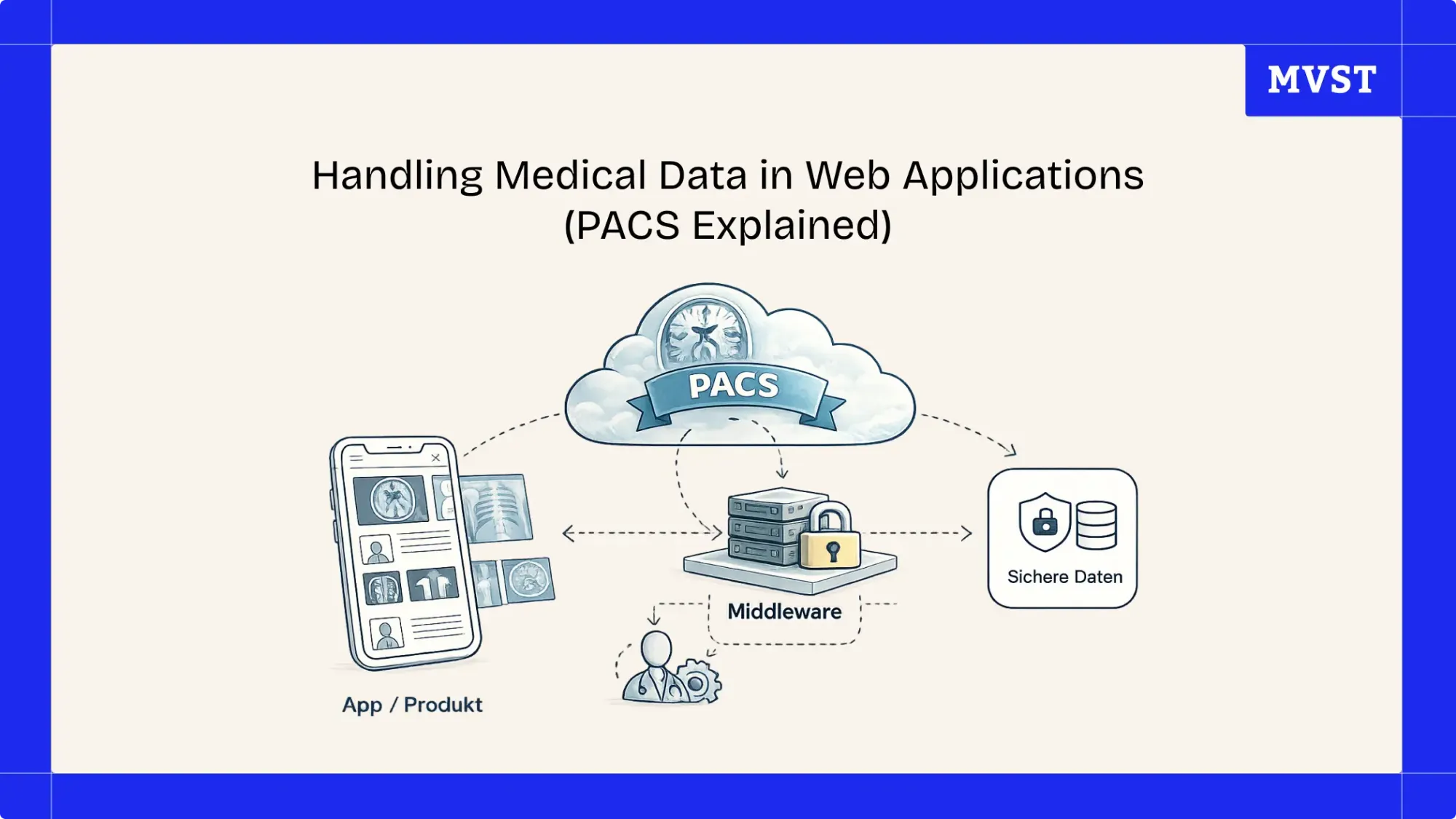
- The role of middleware in PACS-based systems
- Performance and usability considerations
- PACS and compliance
- A real-world context: preventive healthcare products
- Key takeaway
- Looking at a similar challenge?
Handling medical data in web applications is fundamentally different from working with typical user data.
Medical files are larger, more complex, more sensitive, and subject to stricter regulations.
As a result, systems that work well for standard documents or media quickly reach their limits.
This is where PACS comes into play.
What is PACS?
PACS stands for Picture Archiving and Communication System.
It is a system used in healthcare to:
- Store medical imaging data (such as MRI or CT scans)
- Organize and retrieve those images
- Share them between medical professionals and systems
Traditionally, PACS systems were designed for closed clinical environments, not for modern web applications.
Bringing PACS into the web introduces a completely new set of challenges.
Why medical imaging is hard to handle on the web
Medical imaging data differs from typical files in several ways:
- File sizes are very large
- Formats are specialized (for example, DICOM)
- Data often includes embedded patient information
- Files are not meant to be downloaded or freely shared
- Performance requirements are high
A naïve “upload and display” approach is not just inefficient, it can be unsafe.
PACS and web applications: a mismatch by default
PACS systems were not built with web-based user interfaces in mind.
They assume:
- Trusted internal networks
- Specialized viewing software
- Strictly controlled access
Web applications, on the other hand:
- Are exposed to the internet
- Serve many different user roles
- Must balance usability with security
Connecting these two worlds requires careful architectural decisions.
Why direct access is a problem
One of the biggest risks when handling medical data is direct exposure.
Directly connecting a frontend to raw medical files can lead to:
- Uncontrolled data access
- Accidental data leakage
- Security vulnerabilities
- Compliance violations
For this reason, modern systems avoid exposing PACS data directly to the frontend.
Instead, access is mediated and controlled.
The role of middleware in PACS-based systems
Middleware becomes a critical layer when PACS is involved.
It allows systems to:
- Control exactly which data is requested
- Restrict access based on user roles and context
- Transform medical data into safe, usable representations
- Prevent raw files from being exposed
Rather than letting the frontend “talk to PACS,” middleware enforces strict boundaries between systems.
Performance and usability considerations
Medical images are large and complex, but users still expect responsive interfaces.
This creates tension between:
- Performance
- Security
- Accuracy
Typical strategies include:
- Streaming image data instead of loading full files
- Preprocessing data server-side
- Limiting resolution or detail based on context
- Caching non-sensitive derivatives
All of these decisions must be made without compromising data protection.
PACS and compliance
Medical imaging data is almost always considered highly sensitive personal data.
That means PACS-based systems must support:
- Strict access control
- Auditability
- Clear data lifecycles
- Region-aware data handling
Compliance requirements like GDPR are not separate from PACS, they are deeply intertwined with how PACS data is accessed and processed.
A real-world context: preventive healthcare products
In preventive healthcare products like aeon, PACS-related data cannot be treated like normal application content.
Architectural decisions must ensure that:
- Medical data is isolated from user-facing systems
- Access is limited to clearly defined scenarios
- Data exposure is minimized by design
In these contexts, PACS is not just a storage system - it is a responsibility boundary.
Key takeaway
Handling medical data in web applications requires more than technical integration.
PACS introduces constraints that shape:
- Architecture
- Security
- Middleware design
- User experience
Modern systems must bridge clinical standards with web realities, without compromising safety, privacy, or trust.
Looking at a similar challenge?
If you’re working on a product that needs to handle medical imaging or other highly sensitive data, PACS integration requires careful architectural planning.
If you’d like a second perspective on how to approach this responsibly in a web-based system, feel free to reach out.
Newsroom Ideas, Design & Technology in Motion
Practical insights on AI integration, headless e-commerce, UX/UI design, and digital product development. Case studies, implementation guides, and expert perspectives from the MVST team in Munich and Barcelona.

Breastkeeper Institute: A Full Brand Ecosystem, Built End-to-End
Ghida El BadriAug 07, 2026
Zurhorst Meditation Shop: A Conversion-First Relaunch
Ghida El BadriAug 05, 2026
Welcome to MVST, Tudor Verzes
Ghida El BadriJul 20, 2026