
- What authentication actually means
- Authentication vs authorization
- Why authentication is a system concern, not just a feature
- Tokens, sessions, and access over time
- Authentication and middleware
- Authentication in products with sensitive data
- Why good authentication improves user experience
- When authentication becomes complex
- Key takeaway
- Want to talk it through?
How User Authentication Works in Modern Apps
- What authentication actually means
- Authentication vs authorization
- Why authentication is a system concern, not just a feature
- Tokens, sessions, and access over time
- Authentication and middleware
- Authentication in products with sensitive data
- Why good authentication improves user experience
- When authentication becomes complex
- Key takeaway
- Want to talk it through?
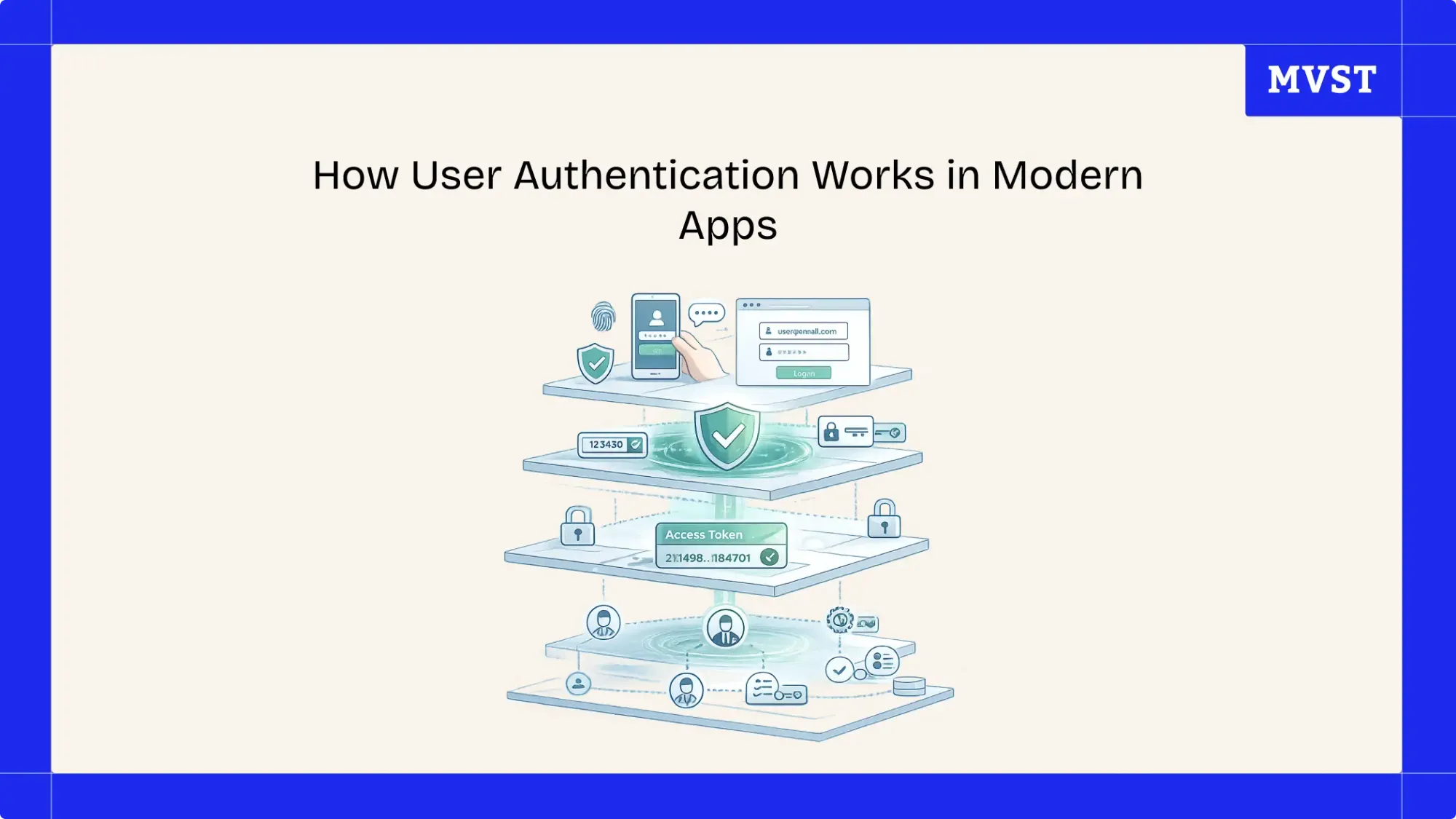
User authentication is often reduced to a simple idea: logging in with an email and password.
In reality, authentication is one of the most important mechanisms in modern applications - shaping security, data access, and product behavior from the very first interaction.
In complex systems, authentication is not just about who you are.
It’s about what you’re allowed to do, when, and in which context.
What authentication actually means
Authentication is the process of verifying that a user is who they claim to be.
This can happen through:
- Email and password
- One-time codes
- Biometric methods
- External identity providers
But authentication alone is only the starting point.
Once a user is authenticated, the system still needs to decide:
- What data they can access
- Which actions they are allowed to perform
- How long access remains valid
- How access changes over time
This is where authentication connects directly to middleware and system architecture.
Authentication vs authorization
These two concepts are often confused, but they serve different purposes.
- Authentication answers: Who is this user?
- Authorization answers: What is this user allowed to do?
Modern apps rely on both.
A user may be successfully authenticated - but still restricted from viewing certain data, performing actions, or accessing specific parts of the system.
Those decisions are typically enforced by middleware, based on authentication signals.
Why authentication is a system concern, not just a feature
In simple apps, authentication might feel like a checkbox.
In modern products, it is a system-wide concern.
Authentication affects:
- Onboarding flows
- Session handling
- Access control
- Data visibility
- Security boundaries
It defines how trust is established between users and the system - and how that trust is maintained over time.
Tokens, sessions, and access over time
Most modern applications don’t rely on permanent logins.
Instead, they use:
- Time-limited access tokens
- Refresh mechanisms
- Session expiration rules
This ensures that:
- Access can be revoked
- Compromised credentials don’t grant unlimited control
- Systems can adapt to changing permissions
Authentication is therefore not a single event, but an ongoing process.
Authentication and middleware
Authentication rarely talks directly to databases or business logic.
Instead:
- Authentication establishes identity
- Middleware interprets that identity
- Middleware decides how requests are handled
This separation allows systems to:
- Apply consistent access rules
- Change permissions without rewriting frontends
- Enforce security centrally
Middleware becomes the layer that turns identity into behavior.
Authentication in products with sensitive data
When applications deal with sensitive or regulated data, authentication becomes especially critical.
It must:
- Be reliable and tamper-resistant
- Support role-based access
- Prevent accidental overexposure of data
- Integrate cleanly with security and compliance requirements
In preventive healthcare products like aeon, authentication doesn’t just protect accounts - it defines how and when sensitive data can be accessed across the system.
Why good authentication improves user experience
Strong authentication is often associated with friction, but when designed well, it can actually improve usability.
Clear authentication flows:
- Build trust early
- Reduce uncertainty for users
- Prevent confusing errors later
- Enable personalized experiences safely
In this sense, authentication is not just a security layer, but a product design decision.
When authentication becomes complex
Authentication grows in complexity when an app needs to:
- Support multiple user roles
- Integrate third-party systems
- Handle long-lived sessions
- Enforce different access rules over time
- Operate in regulated environments
At that point, authentication must be designed as part of the system architecture, not added as an afterthought.
Key takeaway
Authentication is far more than logging in.
It:
- Establishes trust between users and systems
- Defines access boundaries
- Enables secure interaction with sensitive data
- Connects identity to product behavior
In modern applications, authentication is a foundational system component, and a prerequisite for building secure, scalable products.
Want to talk it through?
If you’re building a product where access control, identity, and system boundaries matter, authentication decisions deserve early attention.
If you’d like a second opinion on how authentication fits into your architecture, feel free to get in touch.
Newsroom Ideas, Design & Technology in Motion
Practical insights on AI integration, headless e-commerce, UX/UI design, and digital product development. Case studies, implementation guides, and expert perspectives from the MVST team in Munich and Barcelona.
Breastkeeper Institute: A Full Brand Ecosystem, Built End-to-End
Ghida El BadriAug 07, 2026
Zurhorst Meditation Shop: A Conversion-First Relaunch
Ghida El BadriAug 05, 2026
Welcome to MVST, Tudor Verzes
Ghida El BadriJul 20, 2026