
- What mobile app development actually costs in Germany in 2026
- The 5 factors that drive mobile app development cost
- What's not included in most quotes
- Hidden cost drivers most teams miss
- How to budget for a mobile app in 2026
- E-commerce apps - a separate cost profile
- The honest answer to "what will my app cost?"
How Much Does It Cost to Build a Mobile App in Germany in 2026?
- What mobile app development actually costs in Germany in 2026
- The 5 factors that drive mobile app development cost
- What's not included in most quotes
- Hidden cost drivers most teams miss
- How to budget for a mobile app in 2026
- E-commerce apps - a separate cost profile
- The honest answer to "what will my app cost?"
If you've asked three agencies for a quote and received three completely different numbers, you're not imagining things. Mobile app development costs in Germany genuinely range from €20,000 to well over €300,000 - and both figures can be correct, depending on what you're building.
This post breaks down the real price ranges, explains what actually drives mobile app development cost, and gives you a framework to budget before you talk to anyone.
What mobile app development actually costs in Germany in 2026
Here's the honest breakdown by project type:
| App type | Typical range | What it covers |
|---|---|---|
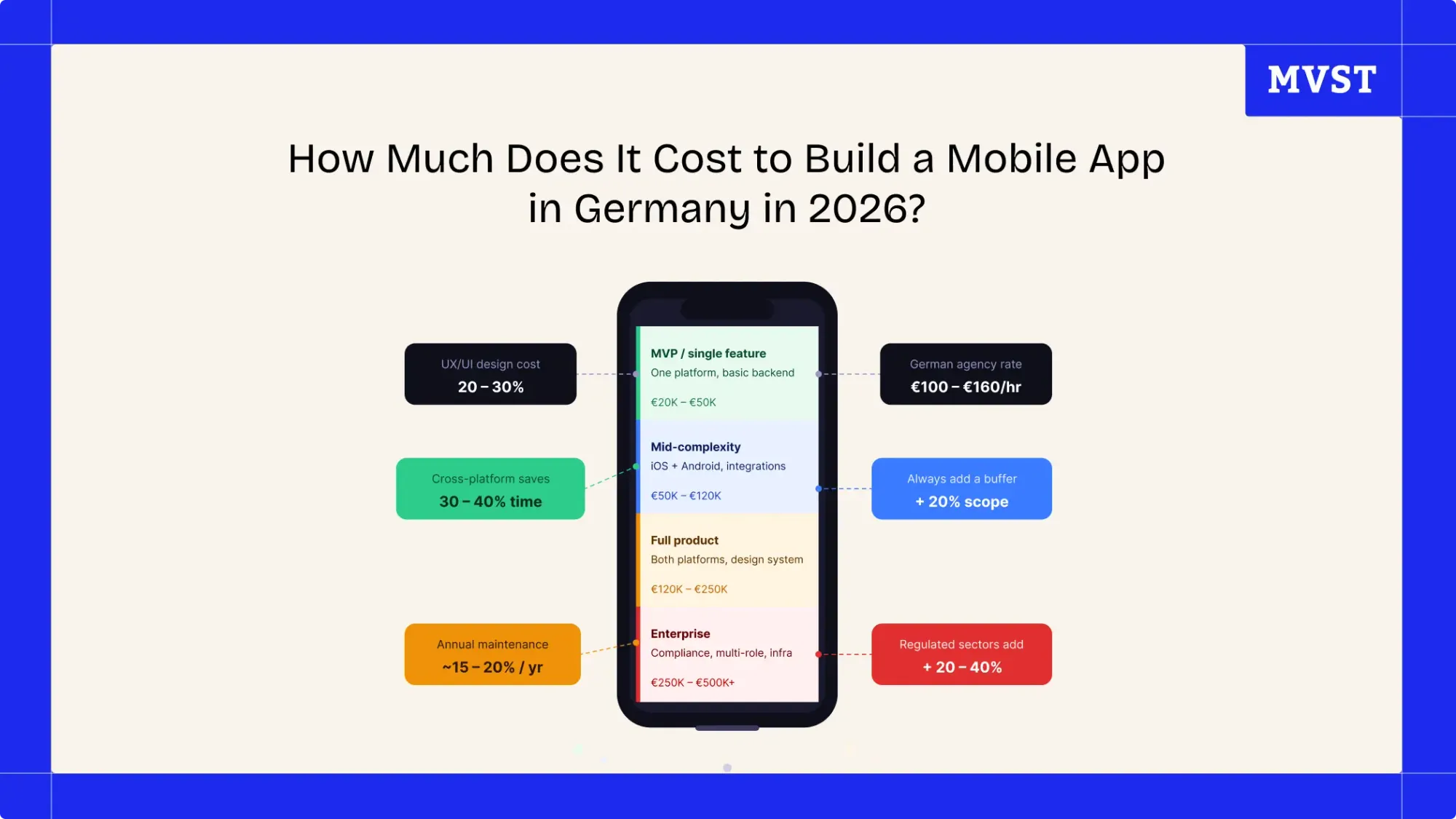
| Simple MVP / single function | €20,000 - €50,000 | One platform (iOS or Android), basic backend, no complex integrations |
| Mid-complexity product | €50,000 - €120,000 | iOS + Android, custom UX/UI, API integrations, auth, basic admin panel |
| Full product with advanced features | €120,000 - €250,000 | Both platforms, complex logic, third-party integrations, full design system |
| Enterprise / regulated product | €250,000 - €500,000+ | Compliance requirements, complex infrastructure, multiple user roles, maintenance included |
These are project costs, not hourly rates. They assume design, development, and product management are included - which they should be if you're working with a digital product studio rather than a freelancer marketplace.
The 5 factors that drive mobile app development cost
1. Native vs cross-platform
Building native apps - iOS in Swift, Android in Kotlin - costs more than cross-platform development using React Native or Flutter. Native gives you better performance and platform-specific UX. Cross-platform cuts development time by roughly 30-40% by sharing code across both platforms.
For most B2B and consumer apps in 2026, cross-platform is the right default. Native makes sense when you need deep hardware integration (camera processing, Bluetooth, AR) or when performance is critical at scale.
2. UX/UI design scope
Design typically accounts for 20-30% of total project cost and is the part most often underestimated. A well-designed app requires user research, information architecture, wireframes, a full design system, and multiple rounds of iteration. Skipping or rushing this costs more in development time later.
3. Backend and integrations
A standalone app with a simple database is cheap. An app that connects to your ERP, a payment gateway, a third-party logistics API, and a CRM is not. Each integration adds development time, error handling, authentication complexity, and ongoing maintenance overhead.
4. Compliance and regulated industries
Healthcare, fintech, and legal apps face requirements - GDPR, MDR for medical devices, BaFin regulations - that add architecture complexity, documentation overhead, and security audits. Expect 20-40% on top of your baseline estimate if you operate in a regulated sector.
5. Where the agency is based
German agencies typically charge €100-€160 per hour. That's higher than Eastern European agencies (€40-€80/hour) and lower than top-tier US or UK agencies (€150-€250/hour). Nearshore and hybrid models - a German studio with developers in Spain, Portugal, or Serbia - are increasingly common and often deliver the best value-to-quality ratio.
What's not included in most quotes
The number an agency sends you in a first proposal often excludes:
- App Store and Google Play submission and setup
- Backend hosting and infrastructure (AWS, GCP, Azure) - ongoing monthly cost
- Ongoing maintenance and updates - typically 15-20% of build cost per year
- Analytics setup (Mixpanel, Amplitude, or custom)
- Push notification infrastructure
- QA testing beyond basic functional testing
Always ask for a total cost of ownership estimate, not just the build cost.
Hidden cost drivers most teams miss
Scope creep is the most common budget killer. A feature that sounds simple in a kickoff meeting - "just add a chat function" - can add weeks of work once you account for real-time sync, push notifications, moderation, media handling, and storage. Agree on a written scope before development starts.
Revision cycles without a clear process are the second biggest driver. Agencies without structured feedback rounds and defined revision windows will charge for every change. Make sure the contract specifies what's included.
Switching costs are consistently underestimated. If you build cheaply and need to rewrite or migrate later, you often spend more than you saved. The best mobile app development companies in Germany will tell you this upfront.
How to budget for a mobile app in 2026
A practical framework:
- Define the core use case - what is the one thing this app must do well?
- List your required integrations - every external system adds cost
- Clarify your platform requirement - one platform or both?
- Add a 20% contingency buffer - scope always grows
- Plan for year-one maintenance - budget 15% of build cost for post-launch support
If you're also evaluating AI features as part of the build, the cost logic mirrors what we've outlined for AI consulting and automation - the complexity of the underlying model and its integrations drives the number more than the feature itself.
E-commerce apps - a separate cost profile
E-commerce apps depend heavily on the platform underneath. A Shopify-backed commerce app is cheaper to build than a custom commerce backend with a native app frontend. Key variables: catalog size, checkout complexity, whether you can use a standard storefront or need a fully custom one.
Rough range for a mid-market e-commerce app: €60,000 - €150,000 for the app itself, excluding platform licences and content.
The honest answer to "what will my app cost?"
More than the first quote - and less than the worst-case scenario, if you plan properly.
Agencies that give you a confident number in the first meeting without asking many questions are the ones to be cautious about. The right partner asks about your backend, your users, your regulatory environment, and your maintenance plan before quoting anything.
If you want a realistic estimate for your specific project, get in touch - we'll give you an honest number based on what you're actually building.
BlogBits und Bytes voller digitaler Einblicke.
Praxisnahe Einblicke zu KI-Integration, Headless E-Commerce, UX/UI-Design und digitaler Produktentwicklung. Fallstudien, Implementierungsleitfäden und Expertenperspektiven vom MVST-Team in München und Barcelona.
Breastkeeper Institut: Ein durchgängiges Marken-Ökosystem, von A bis Z
Ghida El Badri07. Aug. 2026
Zurhorst Meditation Shop: Relaunch mit Fokus auf Conversion
Ghida El Badri05. Aug. 2026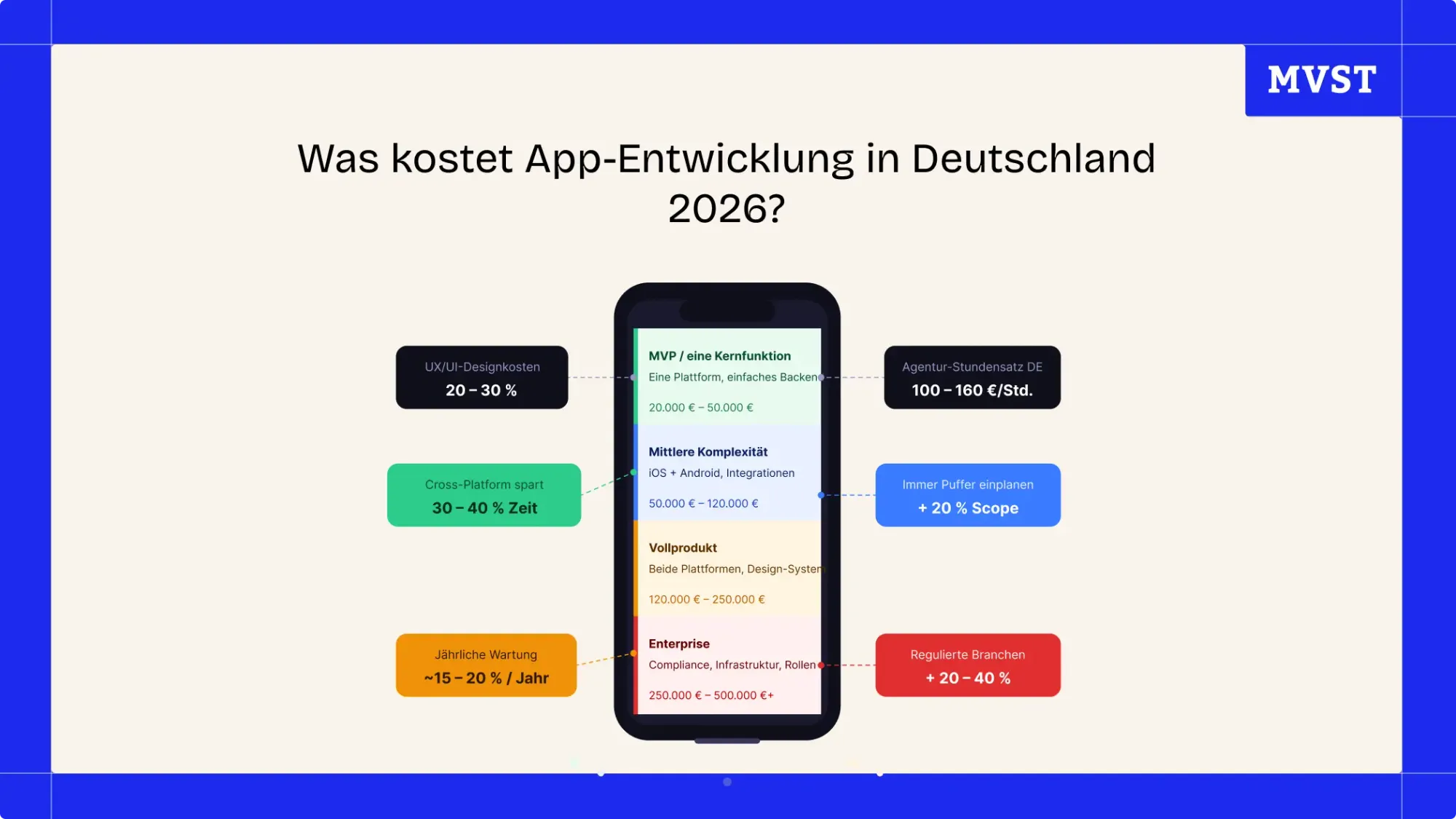
Was kostet App-Entwicklung in Deutschland 2026?
Ghida El Badri17. Juni 2026