
Is Your AI-Built App Ready for Production?
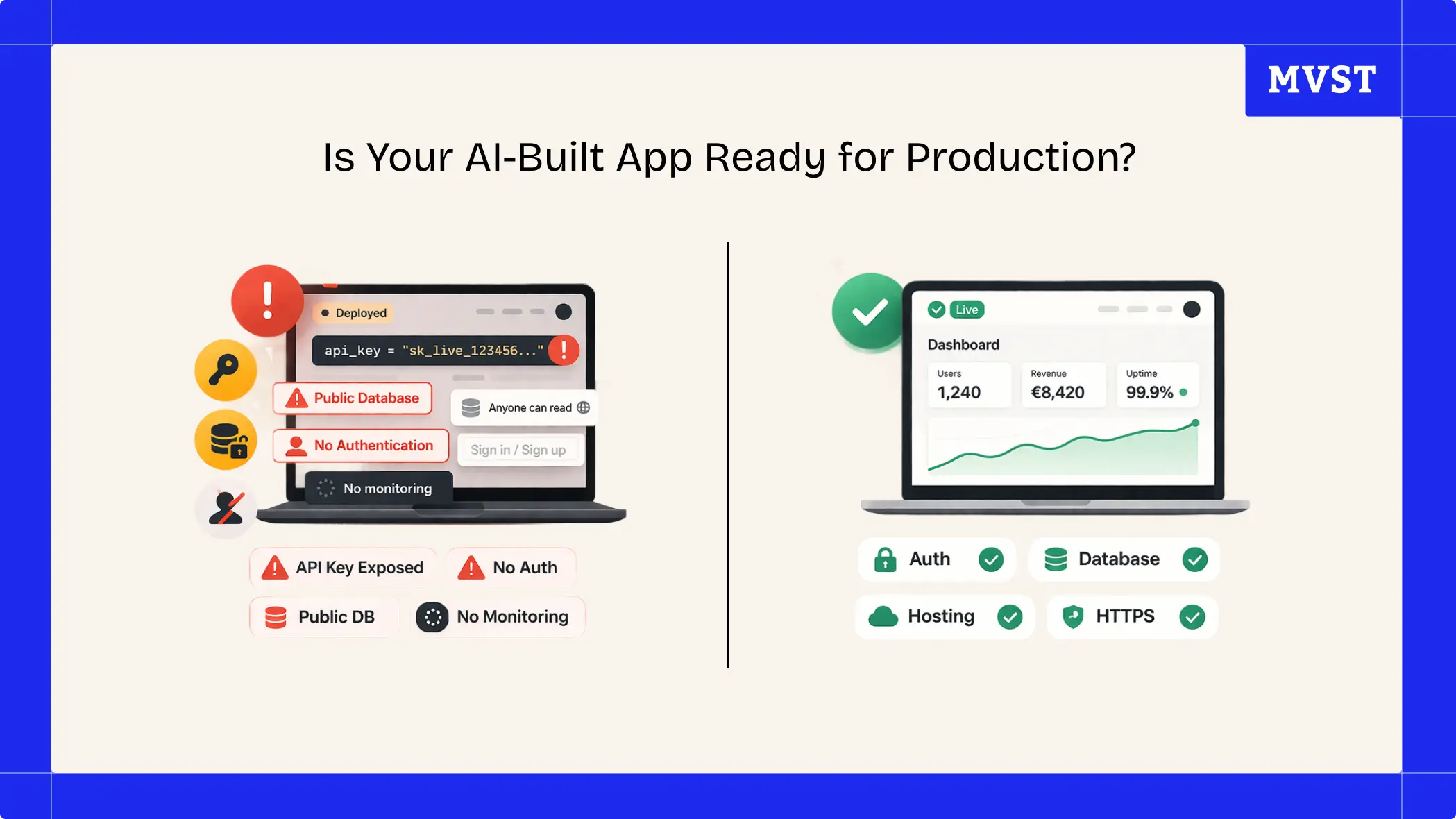
Building with AI has never been easier.
Tools like Lovable, Replit, and Cursor allow you to go from idea to working prototype in hours.
You can generate features, connect APIs, and deploy apps faster than ever before.
But here’s the problem:
👉 Most AI-built apps are not ready for production.
Why Prototypes Feel Ready (But Aren’t)
At first glance, everything works:
- the UI looks clean
- the core features run
- the app is live
But production is different.
Once real users interact with your product:
- edge cases appear
- data becomes sensitive
- systems need to scale
👉 What worked as a prototype starts to break under real conditions.
The Hidden Risks in AI-Built Apps
Most issues don’t show up during development.
They appear right before launch - or worse, after.
Here are the most common ones:
1. Exposed API Keys
AI tools often generate frontend-heavy code.
This can lead to:
- API keys visible in the browser
- direct access to services
👉 One exposed key can compromise your entire system.
2. Unprotected Databases
Quick setups (especially with Supabase or Firebase) often miss:
- access rules
- row-level security
👉 Your database might be publicly accessible without you realizing it.
3. Missing Authentication Logic
Prototypes often skip:
- user roles
- permission checks
- secure session handling
👉 This becomes critical the moment real users sign up.
4. Weak Infrastructure Setup
Many AI-built apps rely on:
- temporary deployments
- unclear environments
- no monitoring
👉 Everything works, until it suddenly doesn’t.
5. No Scalability Planning
Your app works with 10 users.
But what happens with:
- 1,000 users?
- 10,000 users?
👉 Without proper architecture, performance breaks fast.
AI Helps You Build - Not Launch
AI tools optimize for:
- speed
- iteration
- experimentation
They do not optimize for:
- security
- compliance
- stability
That’s why many teams hit the same point:
👉 “Our app works - but we’re not confident launching it.”
What Production-Ready Actually Means
Before going live, your app should be validated across four areas:
Security
- Who can access what?
- Are API keys protected?
- Are endpoints secured?
Infrastructure
- Is hosting stable?
- Are environments correctly configured?
- Can the system handle traffic spikes?
Data & Compliance
- Where is user data stored?
- Is it GDPR-compliant?
- Are logs and data flows secure?
Architecture
- Can the system scale?
- Are dependencies stable?
- Is error handling in place?
From AI Prototype → Production System
Building is just the first step.
The real shift happens here:
👉 from “it works”
👉 to “it’s safe to launch”
That transition is where most teams underestimate the effort.
When to Do a Launch Readiness Check
You should review your app if:
- you built it with Lovable, Replit, Cursor, or similar tools
- you’re planning to launch publicly
- your app handles user data
- you’re unsure about security or infrastructure
👉 The earlier you fix issues, the cheaper and easier it is.
Prepare Your App for Real Users
If you’ve built your product with AI tools,
the next step is making sure it actually holds under real conditions.
We help teams:
- uncover hidden risks
- secure infrastructure
- validate data handling
- prepare for production
👉 Run a launch readiness check before you go live
Final Thoughts
AI is changing how fast we can build.
But speed without stability is a risk.
The difference between a prototype and a real product
is not the idea
Newsroom Ideas, Design & Technology in Motion
Practical insights on AI integration, headless e-commerce, UX/UI design, and digital product development. Case studies, implementation guides, and expert perspectives from the MVST team in Munich and Barcelona.

Breastkeeper Institute: A Full Brand Ecosystem, Built End-to-End
Ghida El BadriAug 07, 2026
Zurhorst Meditation Shop: A Conversion-First Relaunch
Ghida El BadriAug 05, 2026
Welcome to MVST, Tudor Verzes
Ghida El BadriJul 20, 2026