
Why Modern Healthcare Apps Need Middleware
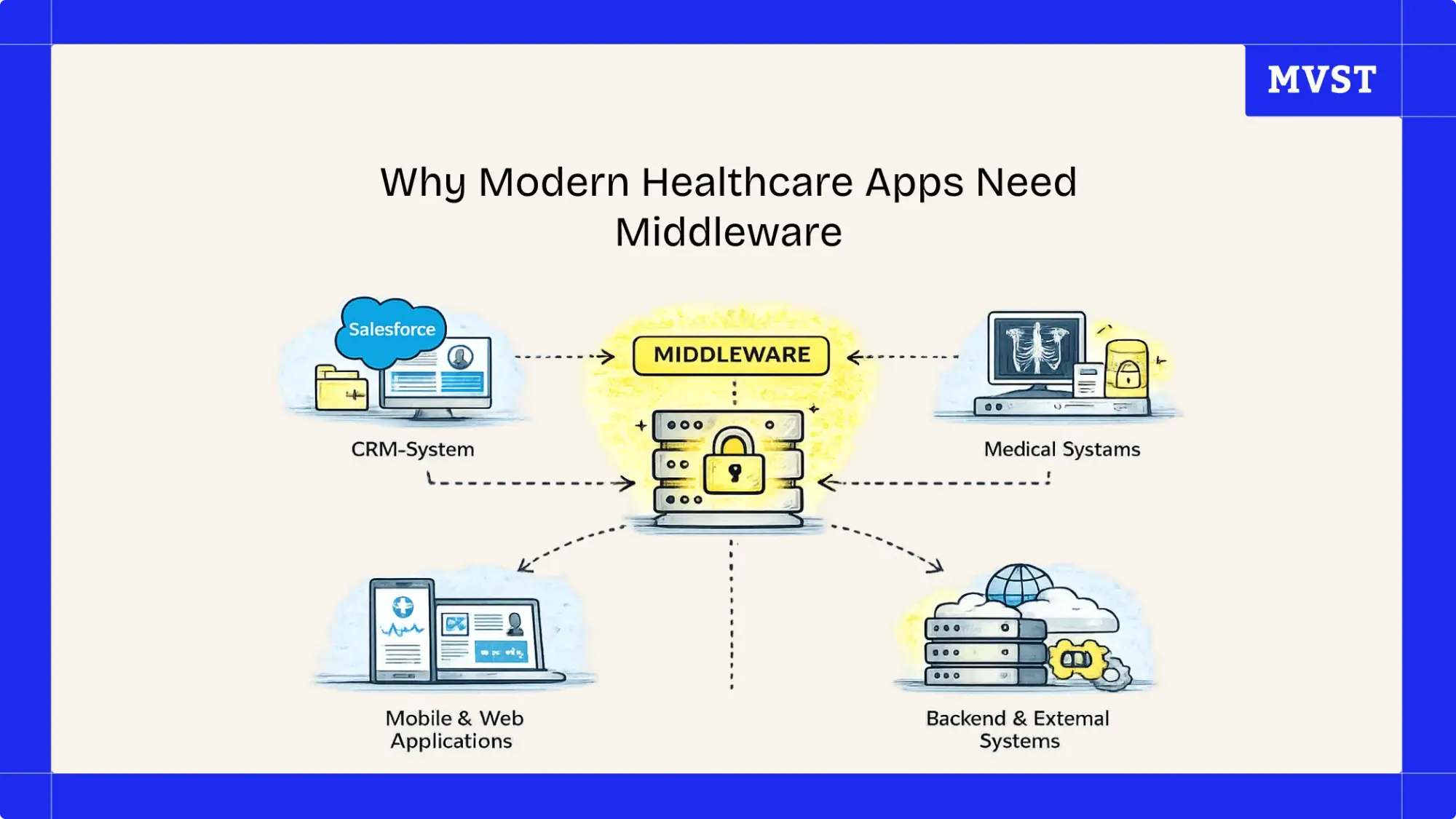
Modern healthcare applications rarely consist of a single frontend connected to a single database.
Instead, they operate across multiple systems:
- Mobile applications
- Web applications
- Backend services
- CRM systems
- Medical imaging platforms
- External integrations
When these systems need to communicate reliably and securely, something has to coordinate the flow of information between them.
That “something” is middleware.
What middleware actually does
Middleware is a software layer that sits between different parts of a system and intercepts requests as they move from one component to another.
Think of it as a controlled gateway.
Every request that moves through the system:
- can be validated
- enriched with additional data
- logged
- filtered
- or blocked entirely
Rather than allowing systems to communicate directly, middleware introduces structure and control.
We explored the concept in depth in Why Modern Apps Need Middleware. In healthcare products, however, middleware becomes even more critical.
Why aeon required middleware
In the case of aeon, the architecture included:
- A native mobile app (iOS & Android)
- A web application
- A backend service layer
- Salesforce as CRM
- A PACS system for medical imaging and result annotation
Each of these systems has its own logic, responsibilities, and data formats.
Allowing them to connect directly would create:
- Tight coupling
- Increased security risks
- Fragile dependencies
- Hard-to-maintain integrations
Middleware was introduced as a dedicated data layer sitting between:
Applications
↓
Middleware
↓
CRM, PACS, backend systems
Its role was to aggregate and coordinate data between Salesforce, PACS, and user-facing applications without exposing internal systems directly.
Middleware vs backend logic
It’s important to distinguish middleware from the backend itself.
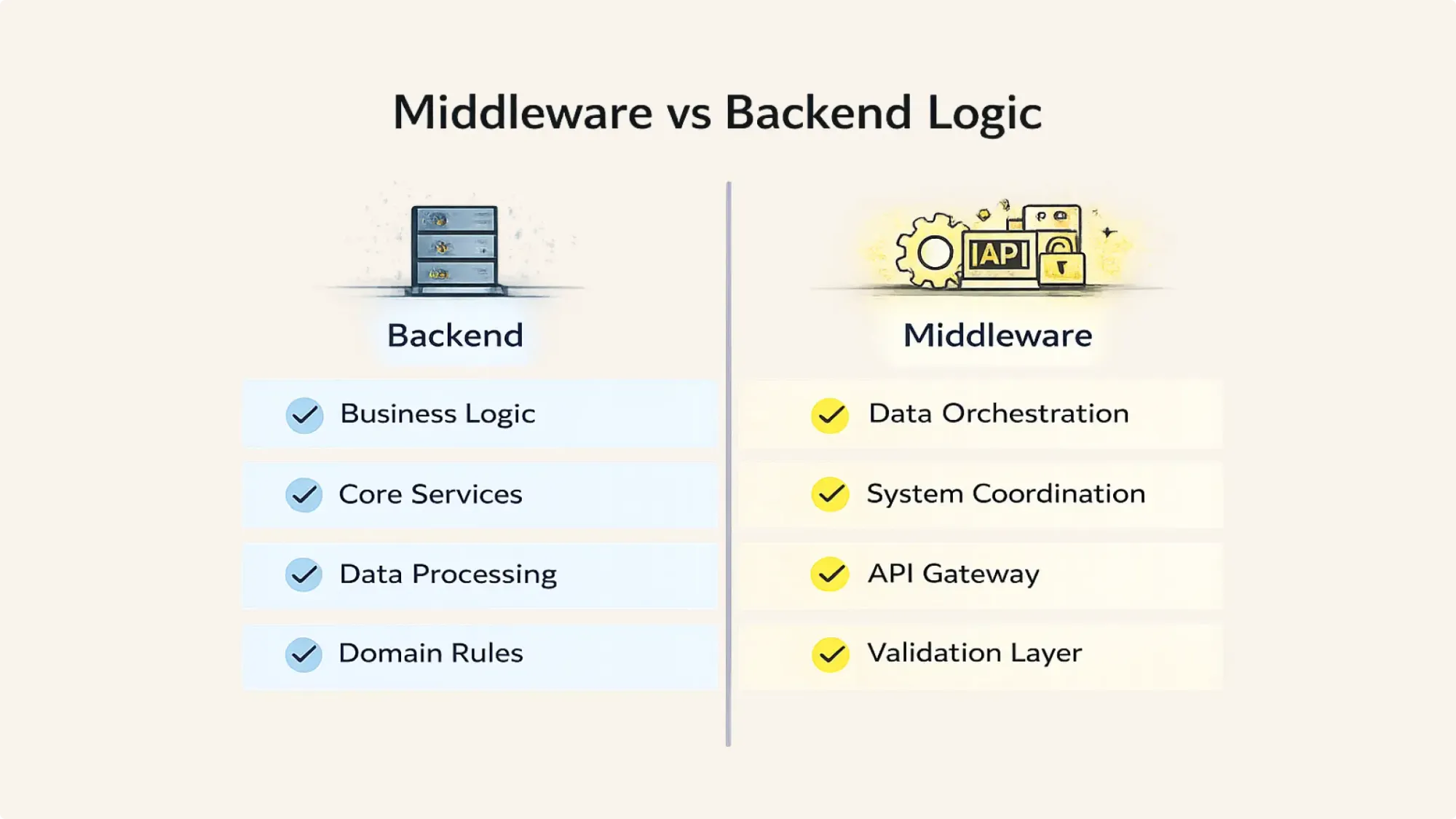
In this architecture:
- Most business logic lives in the backend.
- The middleware acts primarily as a structured data orchestration layer.
It does not replace core backend logic.
Instead, it ensures that:
- Systems remain decoupled
- Integrations are manageable
- Data flows remain controlled
This separation supports the same principles described in How Data Flows Through Modern Applications, where responsibility is distributed across clearly defined layers.
Middleware as a boundary for sensitive systems
When working with healthcare systems such as PACS, direct communication between user-facing applications and medical systems is risky.
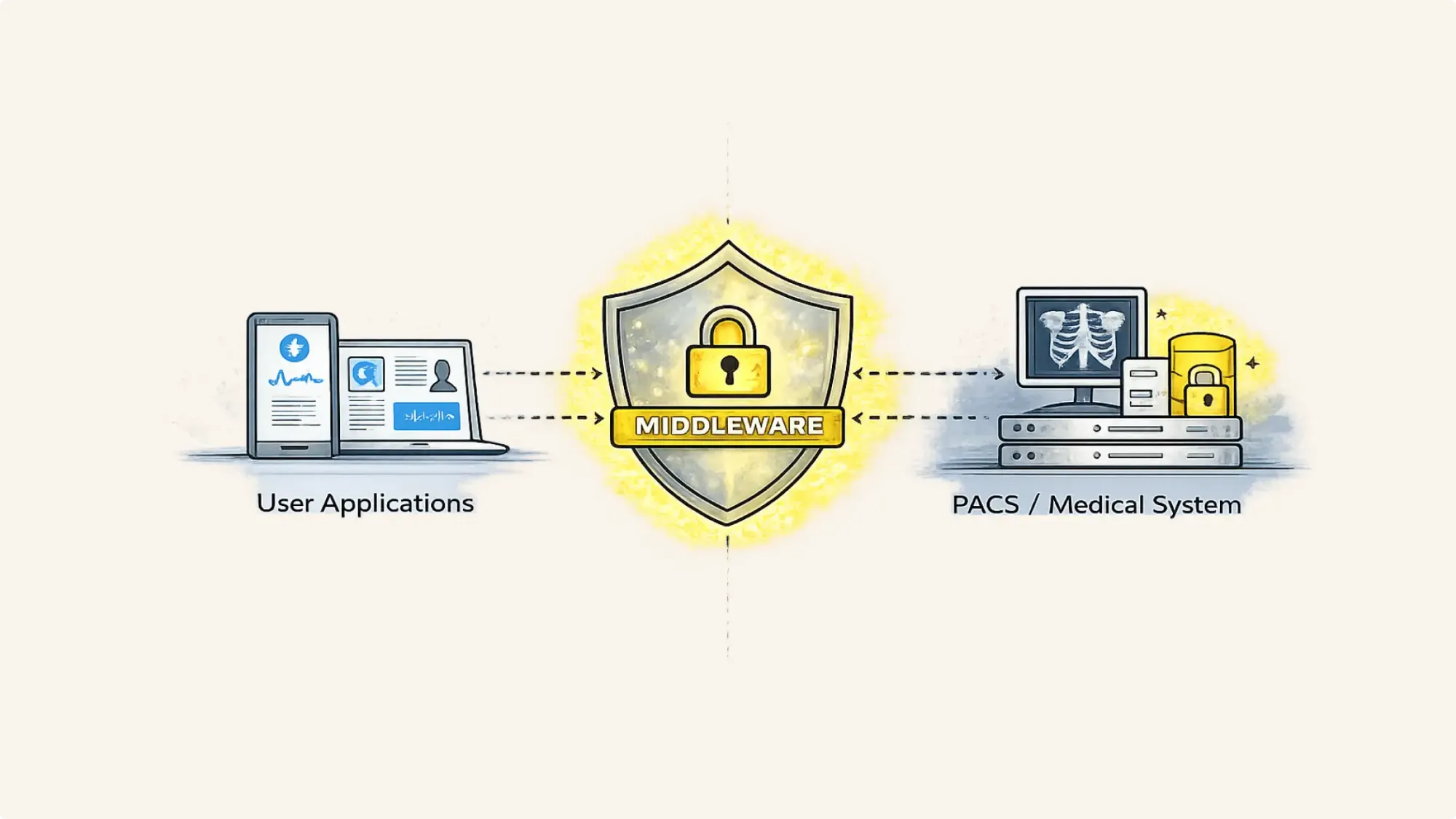
Middleware introduces a boundary.
It ensures that:
- Raw medical data is not exposed unnecessarily
- External systems are not directly accessible from the frontend
- Access control and validation happen before sensitive data moves
This architectural pattern becomes especially relevant when handling medical imaging data, as discussed in Handling Medical Data in Web Applications.
Why this matters in healthcare
Healthcare systems are inherently complex.
They involve:
- Sensitive personal data
- Medical findings
- Regulatory constraints
- Multiple technical stakeholders
Middleware makes it possible to:
- Keep systems modular
- Reduce integration risk
- Adapt to changing requirements
- Scale responsibly
Without it, complexity quickly becomes unmanageable.
You can see how this architectural approach comes together in the aeon showcase, where system boundaries, data orchestration, and product layers are clearly defined.
Key takeaway
Modern healthcare applications need middleware not because it is trendy - but because distributed systems demand structure.
Middleware:
- Coordinates data across systems
- Protects sensitive integrations
- Reduces architectural coupling
- Supports long-term scalability
In regulated environments like healthcare, it becomes a foundational layer.
Building something similar?
If you’re developing a healthcare application that connects multiple systems, whether CRMs, imaging platforms, or custom backends, middleware should be part of the architectural conversation from the beginning.
If you’d like to discuss how to structure a scalable and secure system architecture, feel free to reach out via our contact form.
BlogBits und Bytes voller digitaler Einblicke.
Praxisnahe Einblicke zu KI-Integration, Headless E-Commerce, UX/UI-Design und digitaler Produktentwicklung. Fallstudien, Implementierungsleitfäden und Expertenperspektiven vom MVST-Team in München und Barcelona.

Breastkeeper Institut: Ein durchgängiges Marken-Ökosystem, von A bis Z
Ghida El Badri07. Aug. 2026
Zurhorst Meditation Shop: Relaunch mit Fokus auf Conversion
Ghida El Badri05. Aug. 2026
Was kostet App-Entwicklung in Deutschland 2026?
Ghida El Badri17. Juni 2026