
What's the Difference Between AI Consulting, AI Automation, and AI Development - and Which One Do You Actually Need?
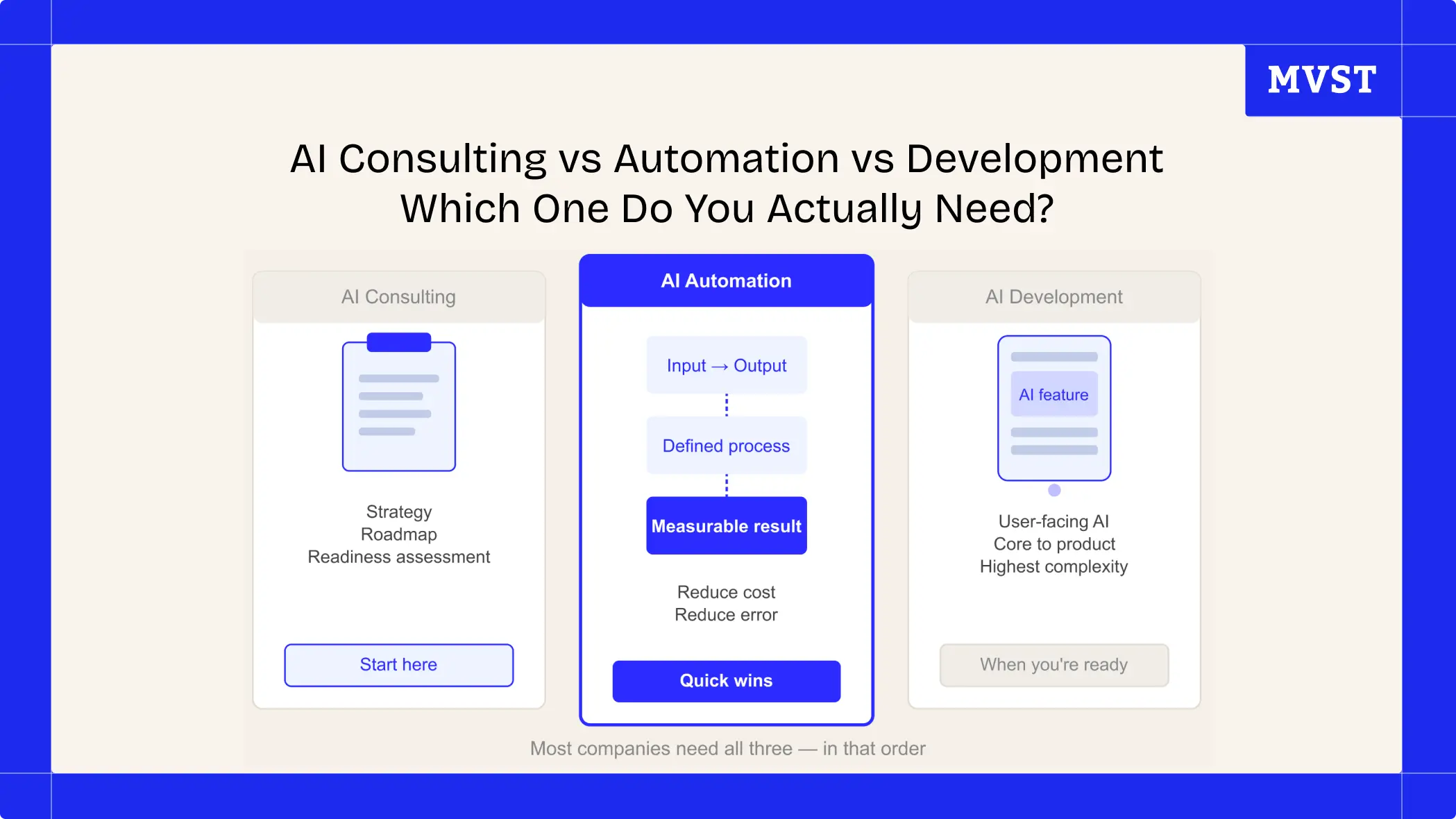
Three terms. One budget conversation. Very different outcomes.
Every vendor, agency, and LinkedIn post uses these terms interchangeably. They're not the same thing. Choosing the wrong one means either paying for a strategy deck when you needed working software, or jumping into development before anyone's figured out what to actually build.
Here's the honest breakdown.
AI Consulting
AI consulting is strategy work. You bring in a team to help you figure out: where does AI actually make sense in your business? What's the right approach? What will it cost? What are the risks?
Good AI consulting delivers: an AI readiness assessment, a prioritised list of use cases, a recommended tech approach, a realistic roadmap, and a cost estimate.
Bad AI consulting delivers: a slide deck with a lot of frameworks and no clear next step.
When you need it: You know AI is relevant to your business but you don't know where to start, what to prioritise, or whether your data and infrastructure are ready. You need someone to map the territory before you spend money building anything.
When you don't need it: You've already done this work internally or with a previous partner and you know exactly what you want to build.
AI Automation
AI automation is about taking a specific, repetitive business process and making it faster, cheaper, or more accurate using AI. It's not about building a product - it's about improving an operation.
Examples: automatically classifying incoming support tickets, extracting data from invoices and routing them to the right system, generating first drafts of reports from raw data, flagging anomalies in sensor data before a human reviews it.
The key characteristic of automation work is that there's a defined input, a defined output, and a clear measure of success. You can usually say: this process currently takes X hours and costs Y - after automation it should take Z minutes.
When you need it: You have a specific operational bottleneck that's repetitive, predictable, and currently done manually. You want to reduce cost, reduce error, or free up your team for higher-value work.
When you don't need it: Your process is too variable or judgment-heavy for automation to handle reliably - or you haven't clearly defined what "success" looks like yet.
A good example: job.ki - an AI agent that parses a user's CV and automatically fills in job application forms with high accuracy, eliminating drop-off caused by repetitive manual input.
AI Development
AI development means building AI-powered features or products - things that end users interact with directly. This is where AI becomes part of your product, not just your back office.
Examples: a personalisation engine that adapts what users see based on their behaviour, a conversational interface that replaces a form or a search bar, a recommendation system, a computer vision feature that processes images in real time.
AI development is typically the most expensive and complex of the three - it involves model selection, infrastructure, data pipelines, UI/UX, testing, security, and ongoing maintenance. It's also where the most value gets created if done right.
When you need it: You're building a product or feature where AI is core to the user experience - not just a back-end efficiency play.
When you don't need it: You're trying to automate an internal process. That's automation, not product development. Don't over-engineer it.
A good example: Akina - AI motion technology built into a physiotherapy app that analyses a user's movements in real time and personalises their sessions accordingly. AI is not a back-end efficiency play here - it is the product.
How they connect
In practice, these three often happen in sequence. You start with consulting to figure out what to build, move into automation to fix the quick wins, and then invest in development for the bigger product opportunities.
The mistake most companies make is skipping straight to development - spending significant budget on building something before they've validated that it's the right thing to build.
If you're still figuring out where AI fits in your business, start with a consulting engagement. If you know the process you want to automate, go straight to automation. If you've done both and you're ready to build a product, then it's time for development.
And before any of those conversations, it helps to know what realistic budgets look like. We broke that down in detail here.
Which one does MVST do?
All three - but always in the right order. We don't push clients into development before the strategy is clear, and we don't sell strategy decks to clients who already know what they need to build.
If you're not sure where you are, the best starting point is a conversation.
BlogBits und Bytes voller digitaler Einblicke.
Praxisnahe Einblicke zu KI-Integration, Headless E-Commerce, UX/UI-Design und digitaler Produktentwicklung. Fallstudien, Implementierungsleitfäden und Expertenperspektiven vom MVST-Team in München und Barcelona.
Breastkeeper Institut: Ein durchgängiges Marken-Ökosystem, von A bis Z
Ghida El Badri07. Aug. 2026
Zurhorst Meditation Shop: Relaunch mit Fokus auf Conversion
Ghida El Badri05. Aug. 2026
Was kostet App-Entwicklung in Deutschland 2026?
Ghida El Badri17. Juni 2026